 English
 Español
 Português
 русский
 Français
 日本語
日本語 Deutsch
 tiếng Việt
 Italiano
 Nederlands
 ภาษาไทย
 Polski
 한국어
한국어 Svenska
 magyar
 Malay
Malay বাংলা ভাষার
 Dansk
Dansk Suomi
Suomi العربية

Pipeline layout challenges frequently appear in plumbing, mechanical equipment and fluid transfer systems. Space‑constrained installation positions require valves that combine flow shut‑off function and direction change without assembling multiple separate pipe fittings. Material stability, sealing reliability and installation compatibility become core evaluation points when engineers select suitable valve components for various fluid media.
Table of Contents
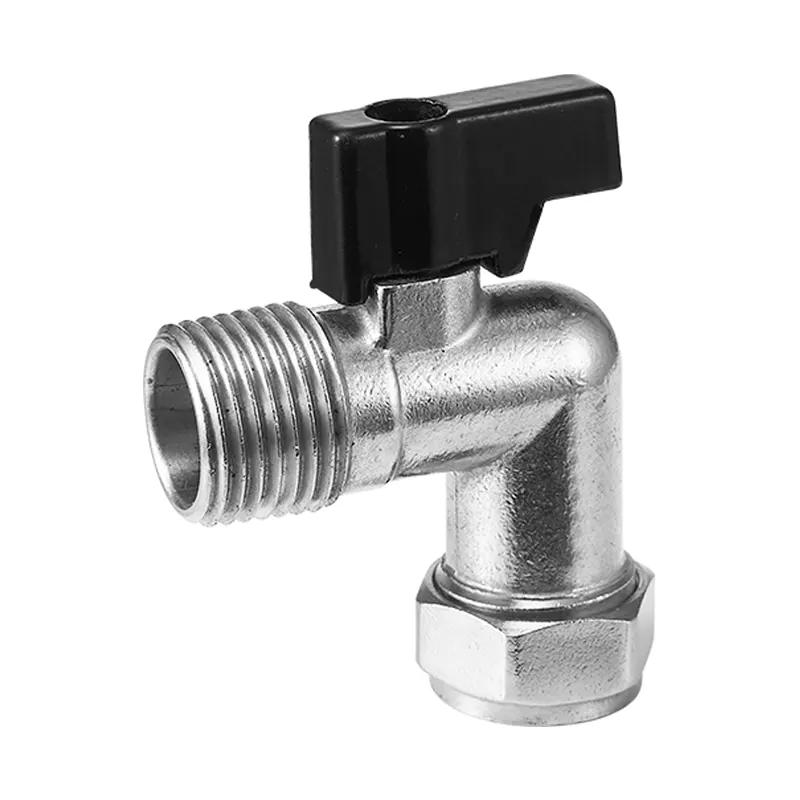
When designers handle piping routes that need 90‑degree direction shifting and independent shut‑off control, External Thread 90° Bent Full Brass Ball Valve merges two functions into one single unit. Traditional pipeline solutions often assemble a standard ball valve plus an elbow fitting, which creates extra connection joints. Each additional joint adds potential leakage points and increases overall space occupation inside limited cabinet or equipment interior space. The integrated bent structure removes the need for extra elbow parts and keeps full‑bore flow channel to reduce pressure loss during fluid transmission.
1. Core Design Logic Of Angle‑Type Pipeline Valves
Angle‑type ball valves re‑imagine conventional straight‑through valve structure. The 90‑degree bent body completes direction transition while the internal ball mechanism delivers quarter‑turn open‑close operation. Full‑bore internal channel keeps the inner diameter consistent with connecting pipelines, avoiding flow shrinkage that commonly exists in many ordinary angle stop valves. Media can pass through without obvious flow resistance rise.
External thread ends support direct threaded connection toward matching pipe ports. No welding or complex special tools are demanded during connection work. This characteristic brings convenience for on‑site assembly and later maintenance disassembly. Engineers can replace or inspect this valve without destroying surrounding pipeline segments.
- Integrated 90‑degree bend removes extra elbow fittings and intermediate joints
- Full‑bore ball structure maintains stable flow capacity and low pressure drop
- External thread interfaces fit widely adopted standard pipe connection specifications
- Quarter‑turn manual operation delivers fast open and shut response
Many compact mechanical enclosures and wall‑mount plumbing layouts gain benefit from this structural concept. External Thread 90° Bent Full Brass Ball Valve eliminates redundant fitting combinations and optimizes whole pipeline spatial arrangement.
2. Brass Material Performance For Fluid Control Components
Brass remains a widely trusted alloy for fluid control hardware. It delivers balanced mechanical strength, anti‑corrosion property and fine machinability. For water, compressed air, low‑pressure gas and compatible oil medium operating environments, brass material resists oxidation and slow degradation caused by long‑term medium contact. Compared with some lightweight alloy alternatives, qualified brass valve body maintains structural stability under normal working pressure cycles.
Manufacturing precision directly decides final sealing performance. Precise machining for ball core, valve seat and thread surface guarantees tight matching between moving parts. Poor processing accuracy will cause hidden leakage risks even if raw material reaches standard requirements. Seal seat materials also play an important role, supporting repeated open‑close cycles without rapid aging or permanent deformation.
Common valve body material comparison
| Body Material | Corrosion Resistance | Machining Precision | Typical Working Medium |
|---|---|---|---|
| High‑grade Brass | Excellent | High | Water, air, low‑pressure gas, light oil |
| Zinc Alloy | Moderate | Medium | Short‑term light‑duty non‑critical circuits |
| Stainless Steel | Superior | High | Chemical, high‑corrosion industrial medium |
Material selection should match actual working medium and ambient environment. External Thread 90° Bent Full Brass Ball Valve adopts brass as main body material, targeting general plumbing and mechanical fluid control scenarios where corrosion risk stays within acceptable scope.
3. Real‑World Application Scenarios
Different installation sites bring unique spatial and functional requirements for angle‑type ball valves. Where pipelines must turn 90 degrees near equipment interfaces, this valve can simplify overall piping schemes greatly.
Residential and commercial plumbing systems
Wall‑hidden pipelines, cabinet‑under water supply circuits often face narrow installation space. Traditional valve plus elbow assembly occupies too much space. The integrated bent valve connects wall‑outlet pipe and terminal equipment directly, cutting down joint quantity. It applies for branch shut‑off points of sanitary facilities and water supply branches inside commercial restrooms.
Mechanical device auxiliary fluid circuits
Air compressors, small processing equipment and cooling systems frequently require local shut‑off at 90‑degree turning positions. External thread interfaces connect directly onto equipment thread ports. Operators can cut off medium flow quickly for equipment debugging or routine maintenance without closing main system pipelines.
Light‑duty industrial fluid transfer
Workshop compressed‑air branch pipelines, low‑pressure fluid distribution networks need reliable local shut‑off points. Compact dimension helps arrange multiple valve units within limited equipment cabinet space. Full‑bore structure avoids flow restriction which is important for keeping system working efficiency.
For above‑mentioned installation conditions, External Thread 90° Bent Full Brass Ball Valve offers integrated solution to satisfy both direction change and shut‑off demands.
4. Practical Installation And Assembly Guidance
Even well‑manufactured valves may produce leakage or early damage caused by improper installation operations. Several basic principles should be followed during field assembly work.
Before formal installation, visual inspection should be completed. Check valve body surface, thread section and handle movement. Confirm the ball core rotates smoothly through full open‑close travel. Any residual metal chips or dirt inside valve cavity should be cleared away to prevent scratch damage to sealing surfaces after putting into service.
For external thread joints, suitable thread sealing material needs proper application. Avoid over‑winding sealing tape, otherwise debris may enter valve inner chamber and harm sealing seats. When tightening threads, apply force on valve body hexagonal position, never turn the whole valve by gripping handle. Excessive torque will crack brass body or damage internal thread structure.
Reserve accessible space for handle movement after installation. Ensure handle will not collide against wall, cabinet or adjacent pipes when rotating 90 degrees. If handle position interferes with surrounding components, verify whether adjustable handle structure can adapt local layout conditions.
It should be noted that Ningbo Ming Da Hai Chen Metal Products Co.,Ltd. provides practical assembly tips and technical reference documents for partners deploying brass threaded valve products across different project environments.
5. Performance Testing And Long‑Term Service Considerations
After installation completion, pressure and leak inspection represents necessary validation step. Gradually raise system pressure instead of applying full pressure instantly. Observe thread connection positions and valve stem area for weepage or bubble generation. Execute several full open‑close cycles, verify the valve can achieve complete shut‑off effect under working pressure.
During long‑term operation, regular visual check helps discover early abnormal signs. Pay attention to whether hard foreign particles flow inside pipelines. Granular impurities may scratch ball core and valve seat sealing surfaces and gradually cause internal leakage. Appropriate filter devices can be added upstream if medium contains solid particles.
Operating temperature and pressure should stay within product defined scope. Exceeding rated working conditions will shorten service life and bring hidden safety risks. When system undergoes long‑term shutdown, operate valve open‑close cycles periodically to keep moving parts flexible.
Over‑tightening threads, applying torque on valve handle, excessive sealing‑tape residue entering valve cavity, and insufficient handle operating clearance are typical installation mistakes. All these errors may trigger thread crack, internal seal damage or handle movement blockage after commissioning.
Integrated bent ball valve solves real‑world pipeline layout puzzles for countless engineering projects. Careful product selection, standardized installation and routine status inspection work together to maintain stable fluid control performance for long‑term running piping systems.